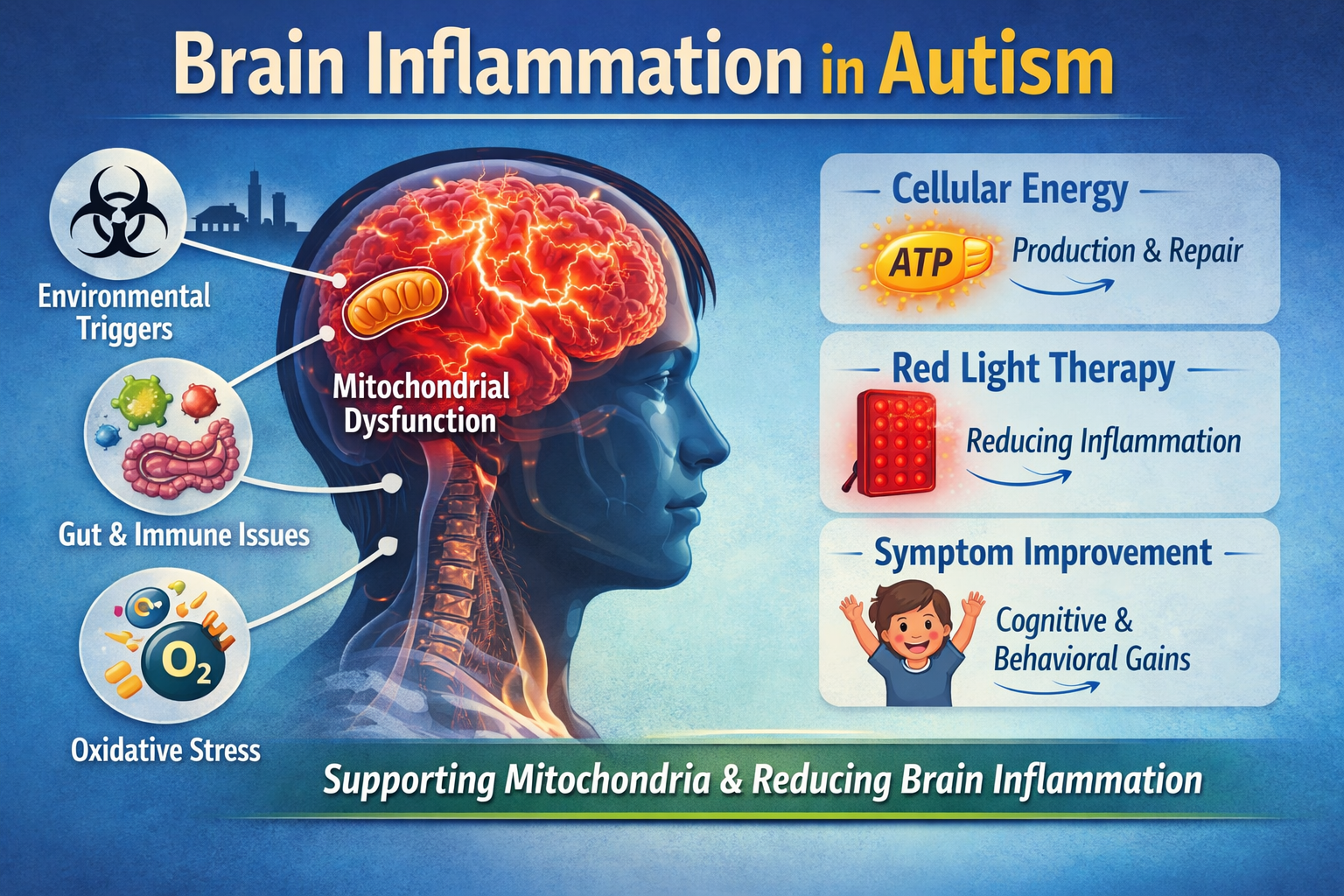
When families begin exploring autism through a functional lens, one concept often surfaces: brain inflammation in autism.
In many children, ongoing immune activation, oxidative stress, environmental exposures, gut dysfunction, and metabolic strain can contribute to neuroinflammatory patterns. When inflammation persists, the brain must work harder to regulate, communicate, and repair.
And beneath that inflammatory layer sits something foundational:
Mitochondrial function.
Brain Inflammation and Autism: Why Cellular Energy Matters
Mitochondria are the structures inside our cells responsible for producing ATP — the body’s primary energy currency.
The brain represents only about 2% of total body weight, yet it consumes roughly 20% of the body’s total ATP at rest. In children, that percentage can be even higher due to developmental demands.
The brain is extraordinarily energy-dependent.
When inflammation increases, energy demand increases.
When mitochondrial efficiency decreases, energy supply decreases.
That mismatch matters.
In children experiencing brain inflammation in autism, we may see:
- Emotional dysregulation
- Cognitive fog
- Fatigue
- Sensory overwhelm
- Irritability
- Slower recovery from illness
- Difficulty with focus or behavioral flexibility
The hopeful reality is this: when inflammation decreases and mitochondrial function improves, symptoms often improve.
A Metabolic Perspective on Brain Function
The relationship between inflammation, metabolism, and brain health has long been understood within functional medicine.
In Brain Energy, Christopher M. Palmer compellingly connects mitochondrial dysfunction to psychiatric and neurodevelopmental symptoms, emphasizing that improving metabolic health can produce profound changes in clinical outcomes.
This reinforces an important principle:
When cellular energy systems are supported — through nutrition, sleep, inflammation reduction, and metabolic optimization — meaningful shifts in symptoms can occur.
Families frequently report improvements in:
- Emotional stability
- Energy levels
- Cognitive engagement
- Sleep quality
- Behavioral flexibility
- Overall resilience
This does not reduce autism to a single cause.
It highlights that the brain cannot function optimally without sufficient energy.
The Brain Cannot Heal While Inflamed
An inflamed brain struggles to repair.
That is why supporting children with brain inflammation in autism requires a layered approach.
We begin with dietary changes. Food can either amplify inflammatory signaling or calm it. Stabilizing blood sugar and removing inflammatory triggers reduces daily immune activation.
We support detoxification pathways so the body can eliminate environmental toxins, microbial byproducts, and metabolic waste. As toxic burden decreases, inflammatory signaling often decreases as well.
We use targeted supplementation to replenish nutrients required for mitochondrial efficiency and antioxidant capacity. Foundational mitochondrial supports such as acetyl-L-carnitine and CoQ10 play direct roles in fatty acid transport and electron transport chain function. When these cofactors are restored, ATP production becomes more efficient and oxidative stress decreases.
In diet and detoxification, we remove what is harmful.
With supplementation, we replenish what the body needs.
While symptoms can suggest mitochondrial strain or elevated toxic burden, functional laboratory testing provides additional clarity. Organic acid testing, nutrient panels, and oxidative stress markers help identify where cellular energy production is struggling and where detoxification pathways may need support. Rather than guessing, we evaluate and personalize.
Once these foundations are in place, it makes sense to consider additional supportive therapies.
Red Light Therapy and Brain Inflammation in Autism
Red light therapy — also known as photobiomodulation — has gained attention in recent years as a supportive tool for brain inflammation in autism, largely because of its influence on mitochondrial function and oxidative stress.
Photobiomodulation uses specific wavelengths of red and near-infrared light that interact with cytochrome c oxidase in the mitochondrial electron transport chain. This interaction can:
- Support ATP production
- Reduce oxidative stress
- Modulate inflammatory signaling
- Improve mitochondrial efficiency
When mitochondrial function improves, the brain has greater access to the energy required for regulation, communication, and repair.
Red light therapy is not a cure.
It is not a replacement for addressing root drivers of inflammation.
It is an adjunctive therapy that may support cellular resilience within a comprehensive plan aimed at reducing brain inflammation in autism.
A Tool the Whole Family Can Use
One of the practical advantages of at-home red light devices is that they can support multiple members of the household.
Beyond potential neurological support, photobiomodulation has been studied for:
- Muscle recovery
- Joint comfort
- Collagen production and skin health
- Circadian rhythm regulation
- Nervous system calming
- General cellular resilience
If you’re considering an investment like this, it makes sense to choose something the whole family can benefit from.
A Hopeful Perspective
Brain inflammation in autism is a physiological state — and physiology can shift.
When inflammation decreases, oxidative stress lowers, mitochondrial function improves, and toxic load is reduced, we often see:
- Greater emotional stability
- Improved cognitive engagement
- Better sleep
- Increased stamina
- More flexible behavior
Healing is rarely one intervention.
It is the cumulative effect of many small, intentional changes working together.
Red light therapy may be one supportive piece of that larger strategy.
If you are considering red light therapy, the companies I respect in this space are listed below. The links provide a discount if you choose to use them.
Hooga
https://hoogahealth.com/?ref=ALESSANDRA12
Mychondria
https://mychondria.com?sca_ref=8676935.ewuupEFw1h
This information is educational and not individualized medical advice. If you are wondering whether brain inflammation or mitochondrial stress may be part of your child’s picture, you are welcome to schedule a complimentary 20-minute discovery call to explore next steps.