I think we can all agree as parents — especially those of us with more sensitive children — that any change in routine can feel overwhelming. Most of you, if you’ve found this blog, are likely searching for answers. You want to help your child heal, but you’re not entirely sure where to start.
Maybe you’ve heard that you “should” remove gluten, dairy, sugar, corn, and soy. And maybe you’ve wondered: What on earth is my child supposed to eat if I take ALL of those things away? Your child is already so picky, barely sits at the table, and the idea of removing everything at once feels unrealistic. And honestly? You’re not convinced it will help enough to justify the battle.
Maybe you’ve already tried removing gluten. You gave it your best shot, but couldn’t find replacement foods your child would accept — especially when the rest of the family was still enjoying their usual meals. Or maybe you managed a few days, and then a holiday or birthday party derailed everything before you saw any change.
You may wonder:
Is this just not for us?
Is there an easier, more sustainable way to help my child feel better?
The truth is, healing often begins in the gut. As Hippocrates famously said, “All disease begins in the gut” — a belief functional medicine continues to explore. And if disease begins there, then healing must begin there as well.
While functional testing can give us deeper answers, we don’t have to wait for expensive labs to start supporting the body. One of functional medicine’s foundational models is the 5R approach, a simple framework that helps us organize where to focus. We begin by Removing irritants and triggers, then Replacing what’s missing, followed by Reinoculating with beneficial microbes, Repairing the gut lining, and finally Rebalancing daily rhythms and routines. It’s not meant to be overwhelming — just a way to understand the order of operations so we can take one step at a time.
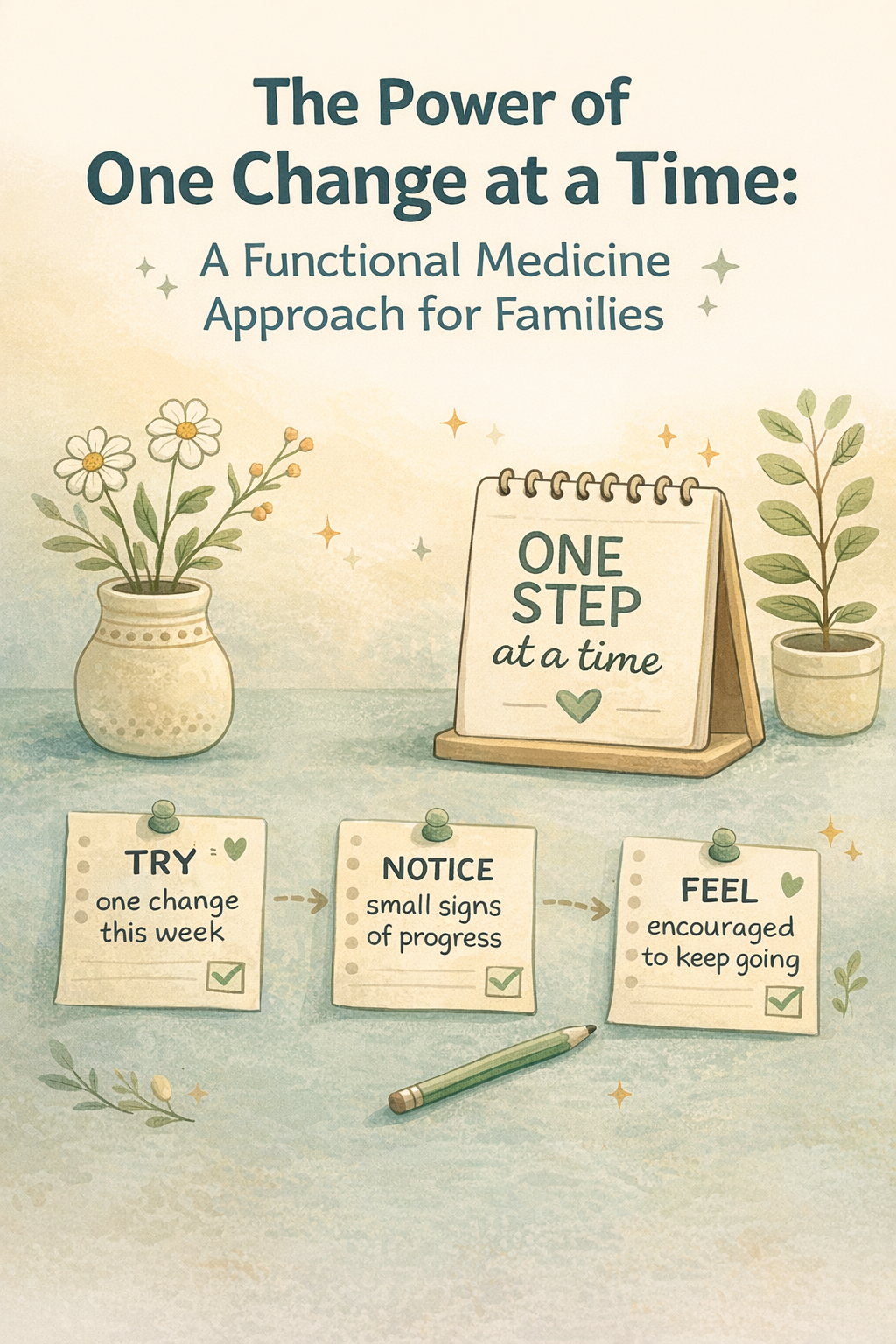
And that one step doesn’t have to be dramatic.
A single shift — like exploring a gluten-free or casein-free diet for autism — can have profound impacts when done consistently. These changes help calm inflammation, support digestion, stabilize behavior, and improve the body’s ability to heal. Small, steady steps often create ripple effects that build upon each other in ways parents don’t expect.
For many families, the first step is removing gluten or dairy — not both at once. It’s reasonable, doable, and often creates enough change that parents feel encouraged to continue. This is the heart of functional nutrition and dietary changes for autism: beginning with what’s manageable, not with what’s perfect.
And here’s something many parents don’t know: gluten and dairy break down into opiate-like compounds. Sensitive or inflamed children can feel chemically “hooked” on these foods, which explains why so many of our kids are intensely picky and gravitate toward the same items over and over. Once you understand that this is biochemical — not behavioral — everything makes more sense.
This is also why making changes as a family unit matters. Our kiddos are smart. It’s hard to expect them to try something new while watching siblings eat the very foods they’re being asked to avoid. When everyone participates, resistance decreases and success increases.
🌿 Why Support Matters
Implementing dietary and lifestyle changes — for yourself or your child — can feel complicated, even when you understand why the changes might help. Many families know that steps like trying a gluten-free or casein-free diet for autism may reduce inflammation or improve mood, digestion, or behavior. But knowing something might help isn’t the same as knowing how to begin, what to prioritize, or how to monitor progress without taking on too much at once.
This is where steady, organized guidance becomes clinically helpful.
One of functional medicine’s foundational models is the 5R approach — a framework that helps us understand where we’re headed and why sequence matters. But translating that into day-to-day life requires clarity:
Which change should come first?
How long should it be tried?
What signs suggest improvement or sensitivity?
When is it appropriate to advance to the next step?
To make changes realistic, we break them down into SMART goals, a simple behavior-change framework used across all aspects of functional medicine. It means choosing steps that are Specific enough to be clear, Measurable so you can track them, Action-focused rather than theoretical, Realistic for your family’s bandwidth, and Time-bound so we know when to reassess. This keeps progress organized and prevents families from taking on more than they can sustain.
When changes are introduced gradually and evaluated thoughtfully, you gain clearer insight, reduce unnecessary trial-and-error, and build confidence through each small success.
Functional medicine isn’t about perfection. It’s about progress.
And progress often begins with the smallest, simplest shifts — especially when they’re made with clarity, consistency, and compassion.
If you’re unsure where to start, overwhelmed by dietary changes for autism, or unsure how to implement a gluten-free or casein-free diet in a realistic way, you’re not alone.
One change at a time is enough — and those changes add up.
If you’d like guidance on where to begin, or you want help mapping out the first few steps in a way that feels realistic for your family, you can schedule a discovery call here. It’s a simple way for us to talk through your goals, your child’s needs, and whether a functional medicine approach might be a good fit.