Understanding Regression Through a Functional Medicine Lens
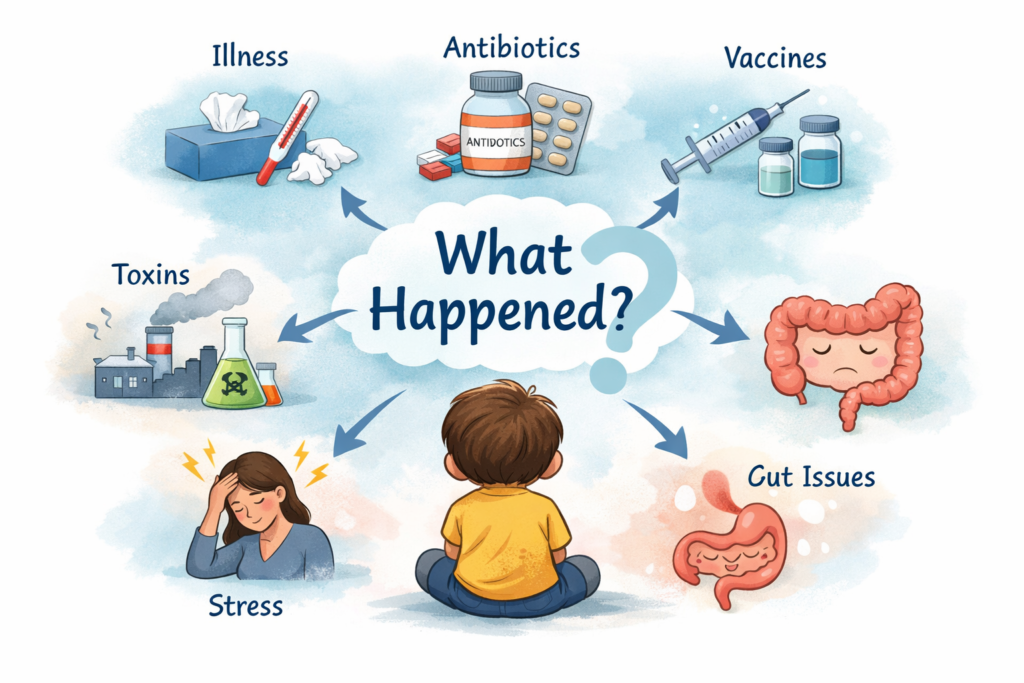
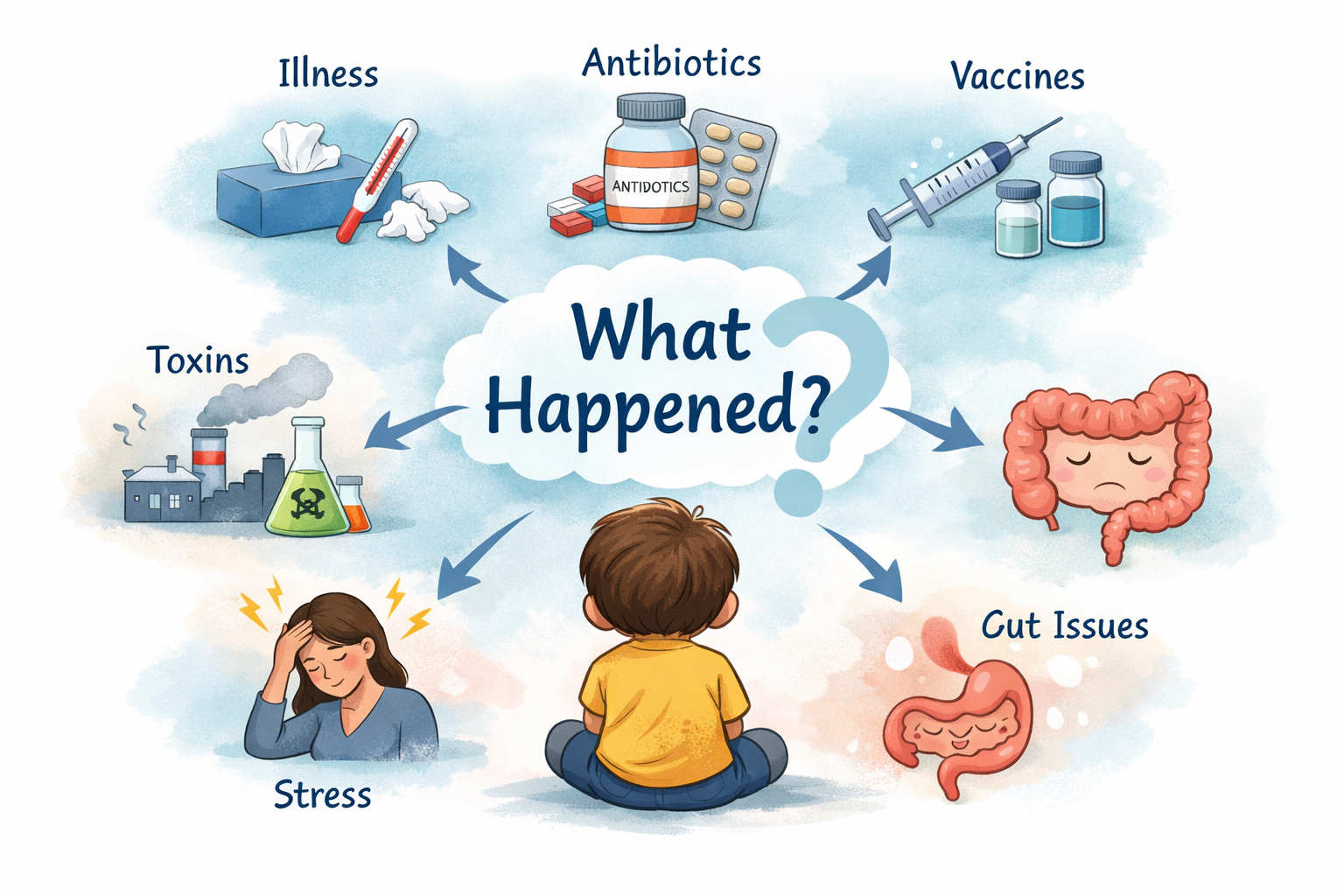
Many parents begin searching for answers after noticing a change or regression in their child — sometimes sudden, sometimes gradual.
Often, there isn’t a single clear explanation. Just a quiet sense that something shifted, and that the answers they’re being given don’t fully explain what they’re seeing.
That question — “what changed?” — is one I hear often. And it’s a very valid place to begin.
What parents often notice first
For some families, changes unfold slowly. For others, they feel more defined.
Parents may notice shifts following illness, antibiotics, medication changes, environmental exposures, or vaccinations — or after periods of emotional stress or developmental transition. These changes may show up in sleep, digestion, regulation, engagement, or behavior.
For some children, regression shows up in communication. Parents may notice a child who had been babbling, vocalizing, or experimenting with sounds become quieter over time — or stop altogether. These changes are often subtle at first and easy to second-guess, especially when they happen gradually. It may not feel like a clear “loss,” but rather a quiet shift that only becomes obvious in hindsight.
What’s often most distressing isn’t just the symptoms themselves — it’s not knowing how to make sense of them.
Looking back often happens later
Many parents don’t begin reconstructing what may have happened until much later.
Sometimes it’s years after the initial changes. Sometimes it’s only after a teacher, therapist, or school professional points out a developmental delay or behavioral concern. Looking back, families often realize there were early signs — changes in communication, regulation, sleep, or digestion — that didn’t feel significant at the time, but now seem important in context.
This delayed clarity is common. And it’s one reason why a thoughtful, whole-picture approach matters.
A different way to ask the question
Functional medicine doesn’t begin by asking what caused autism.
Instead, it asks how the body is functioning, how it responds to stress, and what systems may be under strain. This approach recognizes that symptoms rarely arise from a single factor. More often, they reflect how multiple influences interact within a child’s unique biology over time.
Rather than focusing on one moment, functional medicine looks for patterns.
Toxic load and individual capacity
One lens functional medicine uses is toxic load — the idea that the body is constantly processing environmental inputs and stressors.
Environmental inputs such as pesticide residues in food, hormones in the food supply, mold exposure, emotional stress, adjuvants used in vaccinations, and illnesses or infections can all add to a child’s overall toxic load.
Because of genetic differences in detoxification, immune regulation, and metabolic pathways, not every child has the same capacity to process these inputs efficiently. What one body handles without difficulty may overwhelm another.
When stressors accumulate — especially in a body with limited capacity — they may contribute to immune activation and neuroinflammatory processes, influencing how a child feels, functions, and regulates.
This doesn’t point to a single cause. It highlights why total load and timing matter.
Why timelines and patterns matter
Rather than isolating one event, functional medicine emphasizes timelines and context.
Mapping symptoms alongside life events, illnesses, exposures, and developmental changes often brings clarity — not answers in isolation, but a clearer picture of how things unfolded. This context helps guide where support may be most helpful and what steps to take first.
Timelines allow families to step back, reduce urgency, and move forward with intention rather than fear.
Adding context through labs and history
Alongside timelines and careful observation, functional medicine may incorporate analysis of urine, hair, and stool, paired with a deep dive into a child’s health history.
These assessments don’t provide answers on their own. Instead, they help add context — offering insight into how the body is processing nutrients, eliminating toxins, supporting digestion, regulating the immune system, and responding to environmental stressors. I explore this more deeply in Understanding Your Child’s Symptoms: How Functional Labs Help Paint the Bigger Picture, where I explain how these tools can help connect patterns that may otherwise feel disconnected.
When viewed together with a child’s developmental and medical history, this information can help paint a clearer picture of:
- what environmental or physiological stressors may have impacted the system
- which imbalances may still be present
- and where supportive, meaningful action may be most appropriate
The goal isn’t to test everything or chase numbers. It’s to use information thoughtfully — to understand what may be contributing and what can be supported next.
What support can look like
For many families, support begins with foundations:
- nutrition and digestion
- reducing environmental load
- supporting immune and metabolic balance
From there, families may explore functional medicine labs or provider referrals when appropriate — not as answers in isolation, but as tools to help guide next steps.
The aim is not to do everything at once, but to move forward steadily, at a pace that supports regulation rather than overwhelm.
If you’re asking “what changed?”
You don’t need certainty to begin exploring this question. You don’t need a clear theory or a single explanation.
If you’re trying to make sense of changes you’ve noticed — whether recent or years in the past — a complimentary discovery call can offer a space to organize what you’re seeing and explore whether a functional-medicine-informed approach may be supportive for your family.
If you’d like to begin exploring, you’re welcome to start here.